MergeGlobal, a consulting practice specializing in developing business strategy for companies
in the Global Transportation and Logistics industries, forecasted in 2001 that if currently
available there would be a need for 200 heavy lift air vehicles. In late 2005, Millennium Airship
Inc. produced a marketing study for Lockheed Martin's Advanced Programs division. The study
covered Canada, Alaskan, and Russian documenting the problems with today's transportation
systems in reaching their northern areas, which contain huge amounts of oil, minerals, timber
and other resources. The ability to reach now unreachable oil deposits alone should make a
hybrid vehicle a necessity. If these oil fields were in operation, Canada and the United States
would not have to depend on oil from off shore sources. To satisfy known requirements, the
study indicates that on the low side they would need 285 to 1380 equivalent Fifty (50) Ton lift
air ships.
presents the same result, but for different reasons. The Chinese economy is
growing about 7% per year and the need for the movement of both raw materials and finished
goods remains high. The customer's goal is to double the Gross Domestic Product (GDP) by
2020. To accomplish this goal, the transportation system will have to keep pace. The customer
is spending large sums on highways, railroads, and new, smaller airports in the outer regions.
But there will be a limitation on the operating of large cargo air vehicle, because of the runway
requirements. To satisfy both the mainland and international needs, there will be a requirement
for heavy lift air vehicles. In the long term, air ships will be needed to fulfill the same
requirement as Canada in extracting oil and minerals from the far north, plus the planned
settlement and development of the western frontier. Although the number of air ships required
is not fully quantified, it would probably be not unlike the Canadian northern and Russian north
requirements.
These market studies fully support the immediate need for large capacity carrying hybrid
heavy-lift air vehicles. The next phase should include documenting the cargo types, distances
to travel, number of specific lifting capacity vehicles, the various financial arrangements
necessary to support this program, the specific costs and revenues, and the regulations and
country specific requirements needed to be satisfied. The need for a hybrid air vehicle has
been documented to satisfy known requirements. It is also known that such an air vehicle will
spurn many new areas of transportation not yet defined.
Taken together, these factors and results portray a demanding customer base for intra and
intercontinental cargo transportation. This transportation system must have high and
consistent levels of on-time delivery and lower costs that are routinely required to enable
today's and tomorrows sophisticated global supply chains to operate effectively in high tech,
perishables, strategic resources and other key product segments. In order to capitalize on the
immediate need for hybrid heavy lift air vehicle, the furtherance of the market studies, as well
as initiating the commercial design effort and the planning for the manufacture, delivery,
operations, maintenance and overhaul of these air vehicles should commence immediately.
An Inventory of Possibilities: The Potential for Hybrid Air vehicle in Canada
Introduction
Canada is an immense country with large tracts of inaccessible remote wilderness. Lack of
accessibility across long distances has preserved its natural beauty, but inhibits most resource
development. The construction of single purpose, low traffic density roads through pristine
landscapes is challenging from a cost prospective, while the barriers to environmental approval
may be insurmountable.
Hybrid air vehicle represent a unique solution to many of the transportation challenges
affecting Canadian economic and northern development. In some cases commercial
development is simply impossible without a commercial means of transporting fuel and mine
supplies in, and ore concentrates out. Further, any transportation solution must be
environmentally respectful. Typically, single purpose resource development roads that transect
environmental sensitive lands are not a very palatable solution. Traditional lifestyles are being
challenged by the encroachment of southern ideas and rapid changes to social and
environmental norms.
HHLAV vehicles represent the most logical transportation technology that has any realistic
chance of unlocking the riches of the north and providing a sustainable foundation from which
northern people can enter a modern economic world. In some cases, conventional
transportation options, such as winter roads, can provide a stop-gap, but climate change is
challenging their use. Moreover, these modes are often costly, environmentally disruptive as
well as unreliable. For example, the billion dollar diamond mines in the North West Territories
depend on a twelve week winter road season to move their entire annual fuel and bulk mine
supplies. The consequences and impacts of not being able to re-supply the mine during this
critical period could be financially catastrophic.
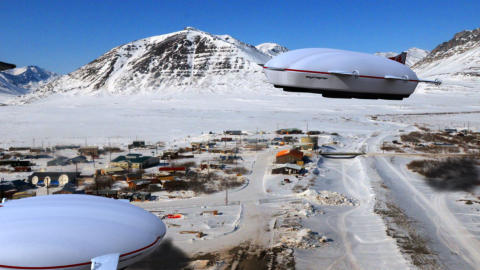
The hardships caused to remote communities when they are not able to obtain necessary
construction materials and heating fuel supplies are hard to imagine. In the south, a delay by
the builder might mean a month before a new home buyer can take possession. In the north, in
what is already a housing crisis situation, this means a whole year's wait. Consider the
aboriginal land claim issues confronting energy and mineral developers. In some cases, it is
simply negotiating an impact-benefit to gain access to a right of way through their land.
However, traditional peoples may not be willing, at any price, to grant access, if roads are the
only option. If a commercially viable means to fly over this same land and leave it undisturbed
were available, the problem would diminish greatly. Hybrid air vehicle provide an elegant
solution to many of the challenges listed above and the best hope for allowing the North to
reach its economic potential.
Historically roads have been viewed as a public good and paid for by governments. More
recently, industries are being asked to build private roads because the government is no longer
willing to shoulder this responsibility. The result often is that the resource remains
undeveloped because of this stalemate on road financing. Roads and railways have been the
only viable technologies for land based bulk transportation. The advent of heavy lift hybrid air
vehicle brings a third option. More importantly, in the case of this new hybrid technology, the
vehicle is the infrastructure. Problems of ground disturbance and infrastructure financing
disappear because hybrids can carry payloads large enough to offer an economically viable
option to conventional transportation.
This report examines the major resource sectors in Canada and presents an inventory of
possible transportation applications where hybrid air vehicle can be the enabling technology
that allows specific resource development projects to proceed. Further the analysis also
explores other social applications such as re-supply to northern remote community and
emergency response, such as forest fires. In the conclusion, the applications are summarized
and some opportunity rankings are provided.
Perspective Setting
Former Prime Minister Mackenzie King encapsulated the economic problem of providing
infrastructure to develop the remote parts of Canada. If some countries have too much history,
we have too much geography. The Canadian population has always been too small, relative to
the financial demand, to construct and maintain all-weather roads or railway lines to most
parts of the country. Moreover, the construction of surface infrastructure is difficult in Canada's
northern regions. The rugged terrain, environmental concerns and the complications posed by
the need to deal with muskeg and permafrost make road construction very expensive.
Transportation challenges discourage investment in industry, limit employment prospects and
increase the cost of living. Without an efficient and economic means of transport, the natural
resource opportunities in the North remain unreachable. High freight rates inflate the cost of
inputs and limit the selection of consumer goods available. Often, Canadians living in the North
are cut off from public services that are taken for granted in the rest of the country. These
socio-economic disparities are greatest in the remote communities that have no all-weather
road access.
The North is served best by air transport. The distances are vast, the infrastructure costs of
air transport are low, and the service is available year round. The technological challenge is the
volume of goods that can be moved economically by small airplanes. If the operating costs of
air transport could be reduced, the socio-economic benefits would be significant. It is for this
reason that the development of a new generation of cargo carrying hybrid air vehicle presents
such an appealing opportunity for the North.
The following inventory of possibilities is explored and specific projects are presented in more
detail. It is equally important to recognize that these projects are the ones that are known
today. As with every major technology innovation, successful introduction represents only a
starting point. Technology is a catalyst for evolving further applications once the potential
becomes understood. Therefore, it is reasonable to expect that hybrid air vehicle will ignite new
exploration and development as it unlocks otherwise inaccessible areas by providing a new
viable option.
Market Prospects
The potential market for hybrid air vehicle in Canada is difficult to estimate because the
reduction in transportation costs and ability to access new areas will create its own dynamic and
generate new demand. In addition, the size of hybrid air vehicle will have a bearing on their
applications. Smaller hybrids will be used for short haul markets, while larger hybrids will be
able to undertake long haul missions. Similarly, larger hybrids will be able to offer the capacity
to open larger scale mining operations that the smaller hybrids cannot serve. In order to
develop an estimate of demand, a standardized unit is needed.
Copyright © 2023
Millennium Airship Inc/SkyFreighter Canada Ltd












MergeGlobal, a consulting practice specializing in developing
business strategy for companies in the Global Transportation and
Logistics industries, forecasted in 2001 that if currently available
there would be a need for 200 heavy lift air vehicles. In late
2005, Millennium Airship Inc. produced a marketing study for
Lockheed Martin's Advanced Programs division. The study covered
Canada, Alaskan, and Russian documenting the problems with
today's transportation systems in reaching their northern areas,
which contain huge amounts of oil, minerals, timber and other
resources. The ability to reach now unreachable oil deposits alone
should make a hybrid vehicle a necessity. If these oil fields were
in operation, Canada and the United States would not have to
depend on oil from off shore sources. To satisfy known
requirements, the study indicates that on the low side they would
need 285 to 1380 equivalent Fifty (50) Ton lift air ships.
presents the same result, but for different
reasons. The Chinese economy is growing about 7% per year and
the need for the movement of both raw materials and finished
goods remains high. The customer's goal is to double the Gross
Domestic Product (GDP) by 2020. To accomplish this goal, the
transportation system will have to keep pace. The customer is
spending large sums on highways, railroads, and new, smaller
airports in the outer regions. But there will be a limitation on the
operating of large cargo air vehicle, because of the runway
requirements. To satisfy both the mainland and international
needs, there will be a requirement for heavy lift air vehicles. In
the long term, air ships will be needed to fulfill the same
requirement as Canada in extracting oil and minerals from the far
north, plus the planned settlement and development of the
western frontier. Although the number of air ships required is not
fully quantified, it would probably be not unlike the Canadian
northern and Russian north requirements.
These market studies fully support the immediate need for
large capacity carrying hybrid heavy-lift air vehicles. The next
phase should include documenting the cargo types, distances to
travel, number of specific lifting capacity vehicles, the various
financial arrangements necessary to support this program, the
specific costs and revenues, and the regulations and country
specific requirements needed to be satisfied. The need for a
hybrid air vehicle has been documented to satisfy known
requirements. It is also known that such an air vehicle will spurn
many new areas of transportation not yet defined.
Taken together, these factors and results portray a demanding
customer base for intra and intercontinental cargo transportation.
This transportation system must have high and consistent levels
of on-time delivery and lower costs that are routinely required to
enable today's and tomorrows sophisticated global supply chains
to operate effectively in high tech, perishables, strategic
resources and other key product segments. In order to capitalize
on the immediate need for hybrid heavy lift air vehicle, the
furtherance of the market studies, as well as initiating the
commercial design effort and the planning for the manufacture,
delivery, operations, maintenance and overhaul of these air
vehicles should commence immediately.
An Inventory of Possibilities: The Potential for
Hybrid Air vehicle in Canada
Introduct
ion
Canada is an immense country with large tracts of
inaccessible remote wilderness. Lack of accessibility across
long distances has preserved its natural beauty, but inhibits
most resource development. The construction of single
purpose, low traffic density roads through pristine landscapes
is challenging from a cost prospective, while the barriers to
environmental approval may be insurmountable.
Hybrid air vehicle represent a unique solution to many of the
transportation challenges affecting Canadian economic and
northern development. In some cases commercial development
is simply impossible without a commercial means of
transporting fuel and mine supplies in, and ore concentrates
out. Further, any transportation solution must be
environmentally respectful. Typically, single purpose resource
development roads that transect environmental sensitive lands
are not a very palatable solution. Traditional lifestyles are being
challenged by the encroachment of southern ideas and rapid
changes to social and environmental norms.
HHLAV vehicles represent the most logical transportation
technology that has any realistic chance of unlocking the
riches of the north and providing a sustainable foundation
from which northern people can enter a modern economic
world. In some cases, conventional transportation options,
such as winter roads, can provide a stop-gap, but climate
change is challenging their use. Moreover, these modes are
often costly, environmentally disruptive as well as unreliable.
For example, the billion dollar diamond mines in the North
West Territories depend on a twelve week winter road season
to move their entire annual fuel and bulk mine supplies. The
consequences and impacts of not being able to re-supply the
mine during this critical period could be financially
catastrophic.
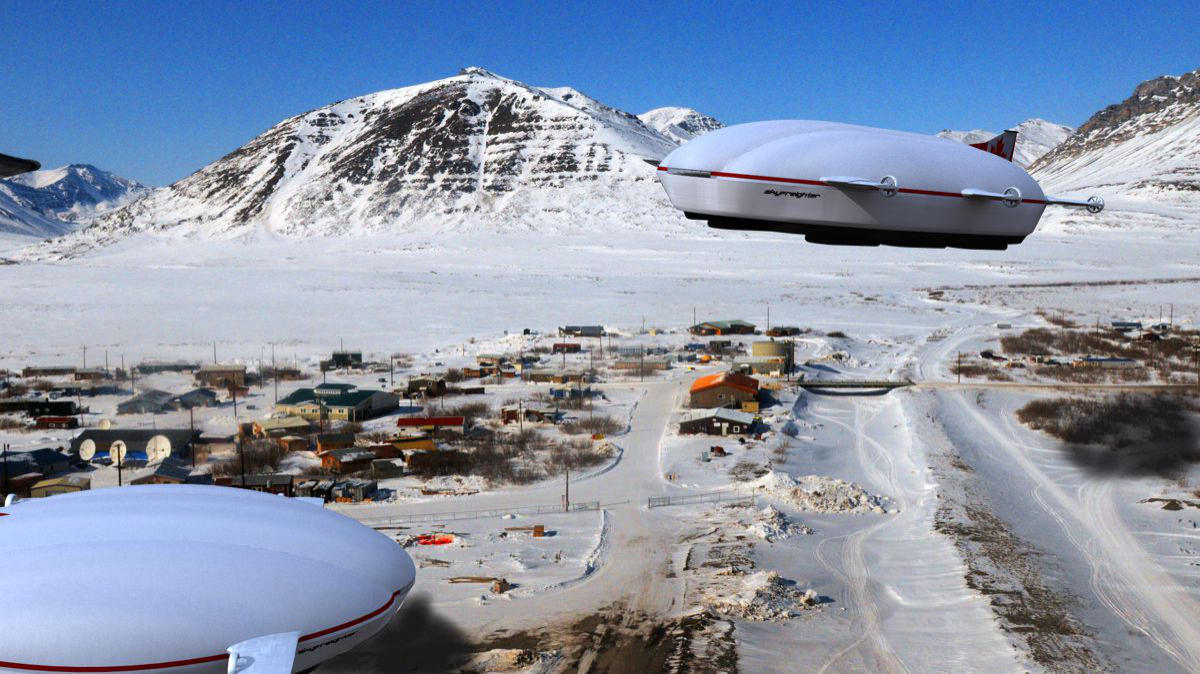
The hardships caused to remote communities when they are
not able to obtain necessary construction materials and
heating fuel supplies are hard to imagine. In the south, a delay
by the builder might mean a month before a new home buyer
can take possession. In the north, in what is already a housing
crisis situation, this means a whole year's wait. Consider the
aboriginal land claim issues confronting energy and mineral
developers. In some cases, it is simply negotiating an impact-
benefit to gain access to a right of way through their land.
However, traditional peoples may not be willing, at any price,
to grant access, if roads are the only option. If a commercially
viable means to fly over this same land and leave it
undisturbed were available, the problem would diminish
greatly. Hybrid air vehicle provide an elegant solution to many
of the challenges listed above and the best hope for allowing
the North to reach its economic potential.
Historically roads have been viewed as a public good and
paid for by governments. More recently, industries are being
asked to build private roads because the government is no
longer willing to shoulder this responsibility. The result often is
that the resource remains undeveloped because of this
stalemate on road financing. Roads and railways have been
the only viable technologies for land based bulk
transportation. The advent of heavy lift hybrid air vehicle
brings a third option. More importantly, in the case of this new
hybrid technology, the vehicle is the infrastructure. Problems
of ground disturbance and infrastructure financing disappear
because hybrids can carry payloads large enough to offer an
economically viable option to conventional transportation.
This report examines the major resource sectors in Canada
and presents an inventory of possible transportation
applications where hybrid air vehicle can be the enabling
technology that allows specific resource development projects
to proceed. Further the analysis also explores other social
applications such as re-supply to northern remote community
and emergency response, such as forest fires. In the
conclusion, the applications are summarized and some
opportunity rankings are provided.
Perspective
Setting
Former Prime Minister Mackenzie King encapsulated the
economic problem of providing infrastructure to develop the
remote parts of Canada. If some countries have too much
history, we have too much geography. The Canadian
population has always been too small, relative to the financial
demand, to construct and maintain all-weather roads or
railway lines to most parts of the country. Moreover, the
construction of surface infrastructure is difficult in Canada's
northern regions. The rugged terrain, environmental concerns
and the complications posed by the need to deal with muskeg
and permafrost make road construction very expensive.
Transportation challenges discourage investment in industry,
limit employment prospects and increase the cost of living.
Without an efficient and economic means of transport, the
natural resource opportunities in the North remain
unreachable. High freight rates inflate the cost of inputs and
limit the selection of consumer goods available. Often,
Canadians living in the North are cut off from public services
that are taken for granted in the rest of the country. These
socio-economic disparities are greatest in the remote
communities that have no all-weather road access.
The North is served best by air transport. The distances are
vast, the infrastructure costs of air transport are low, and the
service is available year round. The technological challenge is
the volume of goods that can be moved economically by small
airplanes. If the operating costs of air transport could be
reduced, the socio-economic benefits would be significant. It is
for this reason that the development of a new generation of
cargo carrying hybrid air vehicle presents such an appealing
opportunity for the North.
The following inventory of possibilities is explored and
specific projects are presented in more detail. It is equally
important to recognize that these projects are the ones that
are known today. As with every major technology innovation,
successful introduction represents only a starting point.
Technology is a catalyst for evolving further applications once
the potential becomes understood. Therefore, it is reasonable
to expect that hybrid air vehicle will ignite new exploration and
development as it unlocks otherwise inaccessible areas by
providing a new viable option.
Market
Prospects
The potential market for hybrid air vehicle in Canada is
difficult to estimate because the reduction in transportation
costs and ability to access new areas will create its own
dynamic and generate new demand. In addition, the size of
hybrid air vehicle will have a bearing on their applications.
Smaller hybrids will be used for short haul markets, while
larger hybrids will be able to undertake long haul missions.
Similarly, larger hybrids will be able to offer the capacity to
open larger scale mining operations that the smaller hybrids
cannot serve. In order to develop an estimate of demand, a
standardized unit is needed.
Copyright © 2023
Millennium Airship Inc/SkyFreighter Canada Ltd